
Before you file, or after. Cited to primary law.
CitedTax reads a return the way a senior technical reviewer would, then walks the Code, the regulations, the published guidance and the court decisions as they stand today. Every finding comes back cited to the operative text and graded by how firmly that text supports it.
One firm license, unlimited users, then $25 a request. Credits never expire. Built for firms, not consumers; the reviewing CPA validates every item. Individual, trust, corporate, S corporation and partnership returns.
- 8 states
- with their full authority stack, plus federal law, Canada and the United Kingdom, kept apart by jurisdiction
- 3 checks
- before a finding is graded VERIFIED: the key exists, the text supports the claim, the quote is in the text
- Overnight
- for a standard review, or about thirty minutes for a rush, review and planning modes in parallel
- 1 firm
- per workspace: your data, your key, your branding
Watch how a firm uses it, end of day to the next morning.
- 01
One file a day
Before you leave, pick a client whose return you know well. One credit.
- 02
Working papers by morning
Every finding cited to primary law and graded by how firmly the text supports it.
- 03
The client report under your name
You decide what the client sees. Nothing goes out without you.
One engine, one currency. Nine things a credit buys.
Return review
LiveUpload a filed or draft return. Working papers, engineering paper and a curated client report, every item cited and graded.
Notice response
LiveUpload the notice. The engine reads it, pulls the return if your firm has run it, and drafts the cited response in your firm's name. Revisions included.
Penalty abatement
LiveFirst-time abatement or reasonable cause, with the Internal Revenue Manual procedure cited section by section.
Research memo
LiveAsk a question about a client. The memo answers it with the fact-to-law chain and evidence grades, addressed to your firm.
Multi-state and entity memo
LiveA matrix for a client changing states, or an entity-choice memo on a specific return. Review-sized research.
Protest and petition
LiveDispute an examination result or a collection notice: a formal protest to Appeals that meets Publication 5, the Tax Court petition if a deficiency notice has issued, or the collection due process request. Drafted in your firm's name.
Offshore disclosure
LiveCome into compliance on unreported foreign accounts or income: the streamlined procedures where the conduct was non-willful, the Voluntary Disclosure Practice where it was not, with the years, the tax, the penalties and the certification narrative.
Letter ruling request
LiveA private letter ruling request, including relief for a missed election under Reg. 301.9100-3: facts, analysis, the required statements and the declaration, in the order the revenue procedure requires.
Refund claim
LiveA claim for refund on Form 1040-X, 1120-X or 843 that meets the regulation: timely under section 6511, each ground set out in detail with the facts and the authority, the interest claimed.
Included with a review
Free- Client cover letter and "why we recommend amending" letter
- Engagement letter
- Form 1040-X or 1120-X explanation statement
- Client planning questionnaire
- "What the new law changed for you" note
Read the deliverables before you talk to us.
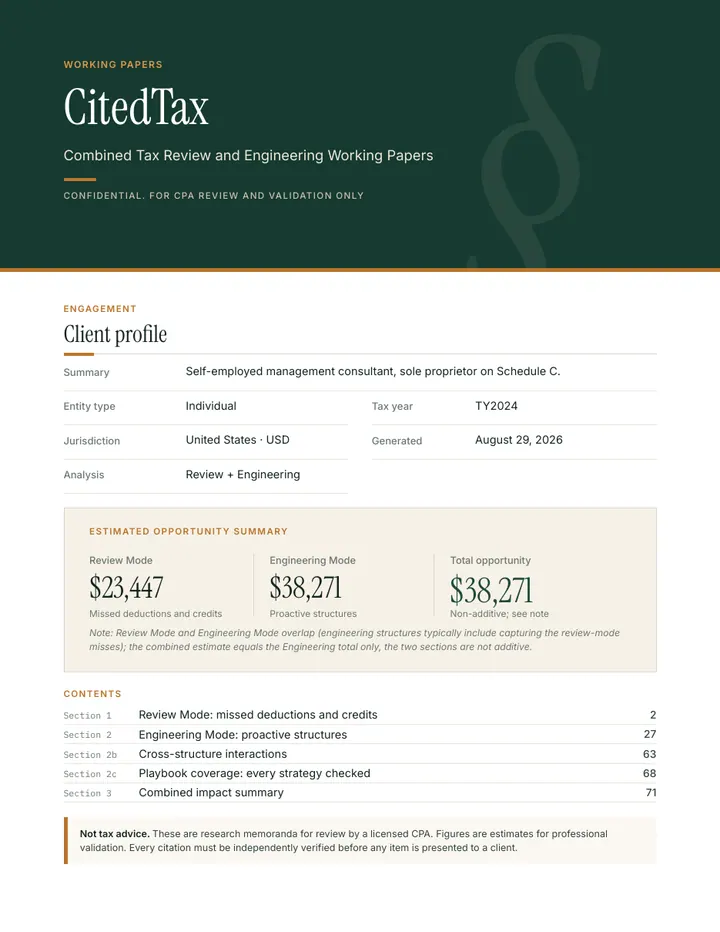
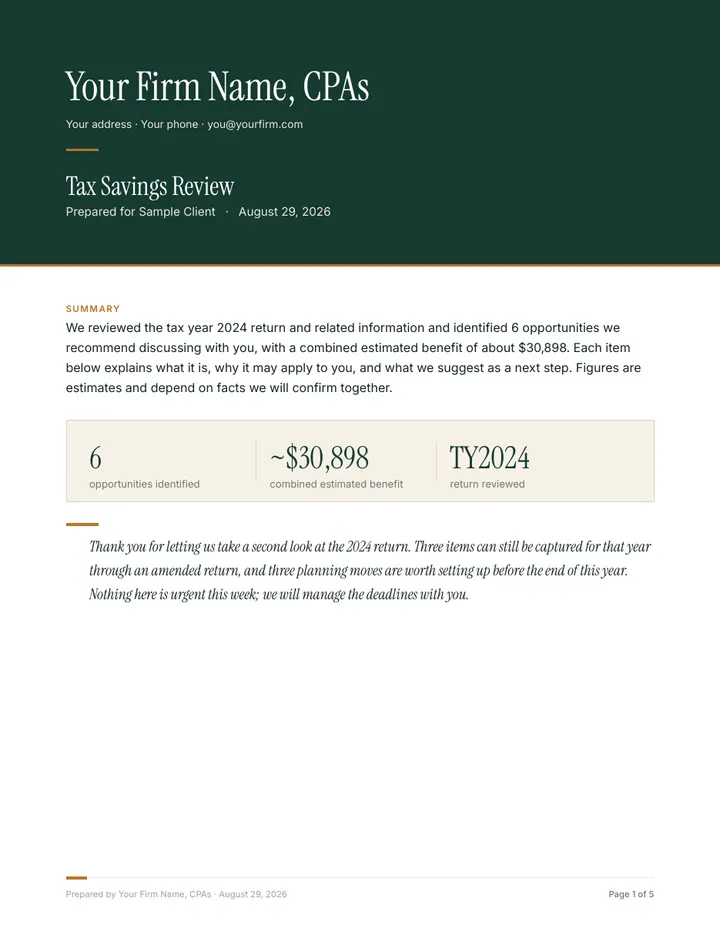
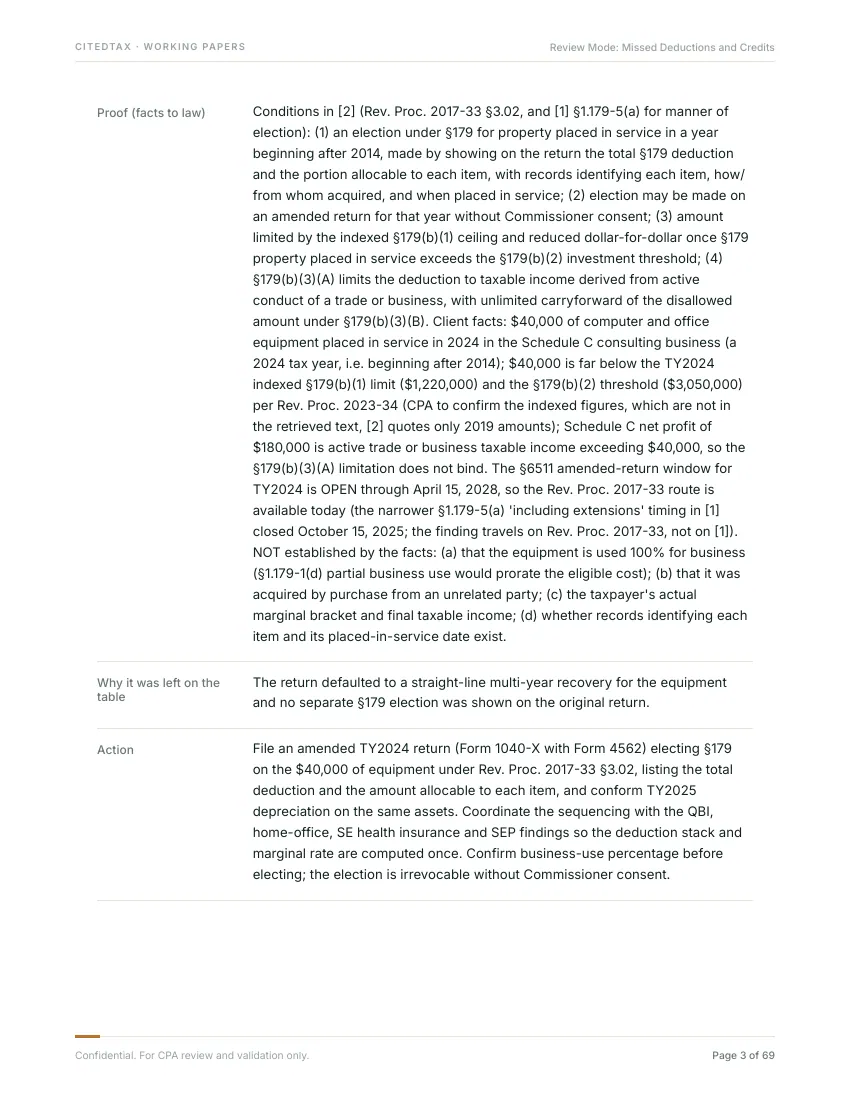
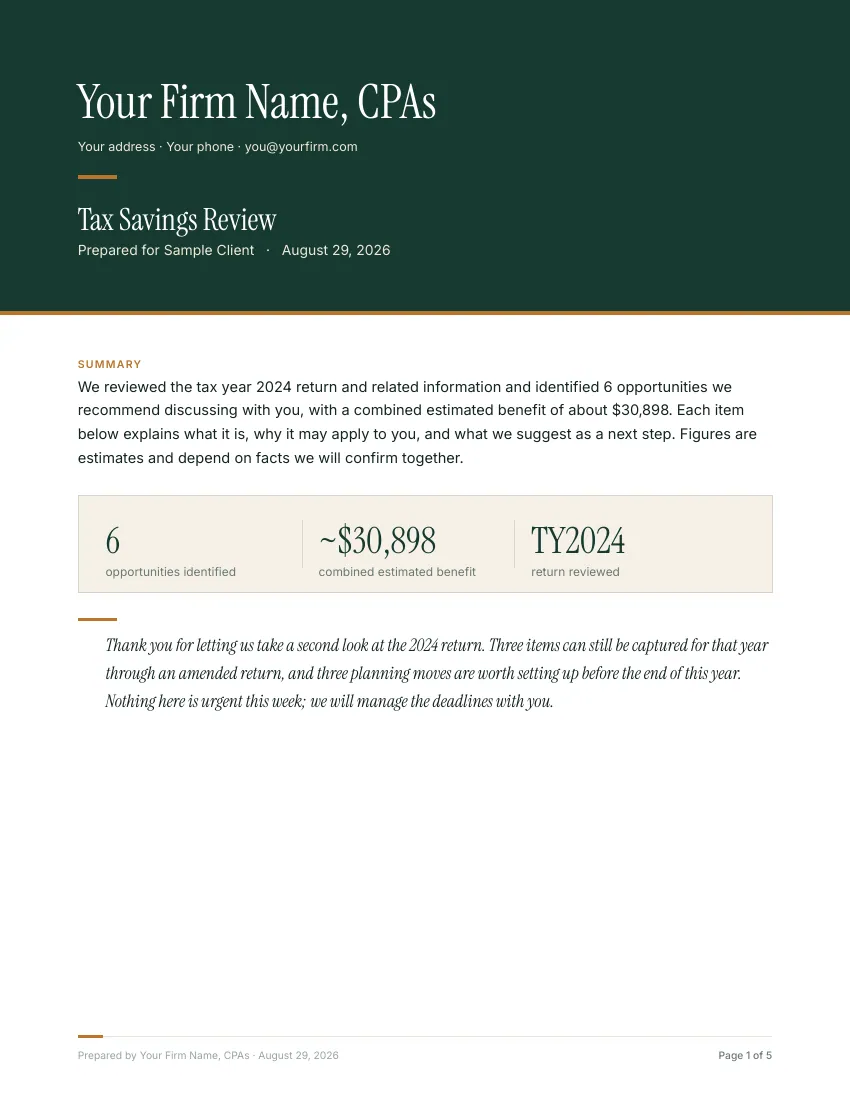
Both samples are rendered from a synthetic fact pattern (a sole-proprietor consultant on Schedule C, TY2024) so they can be shared freely. The grades you see are the ones the gate gave them.
One sample of every other request.
Same rule: synthetic facts, run through the engine, so every citation grade you see is the one the gate gave it. The firm name is a placeholder; the sections marked for the firm to remove before sending are left in.
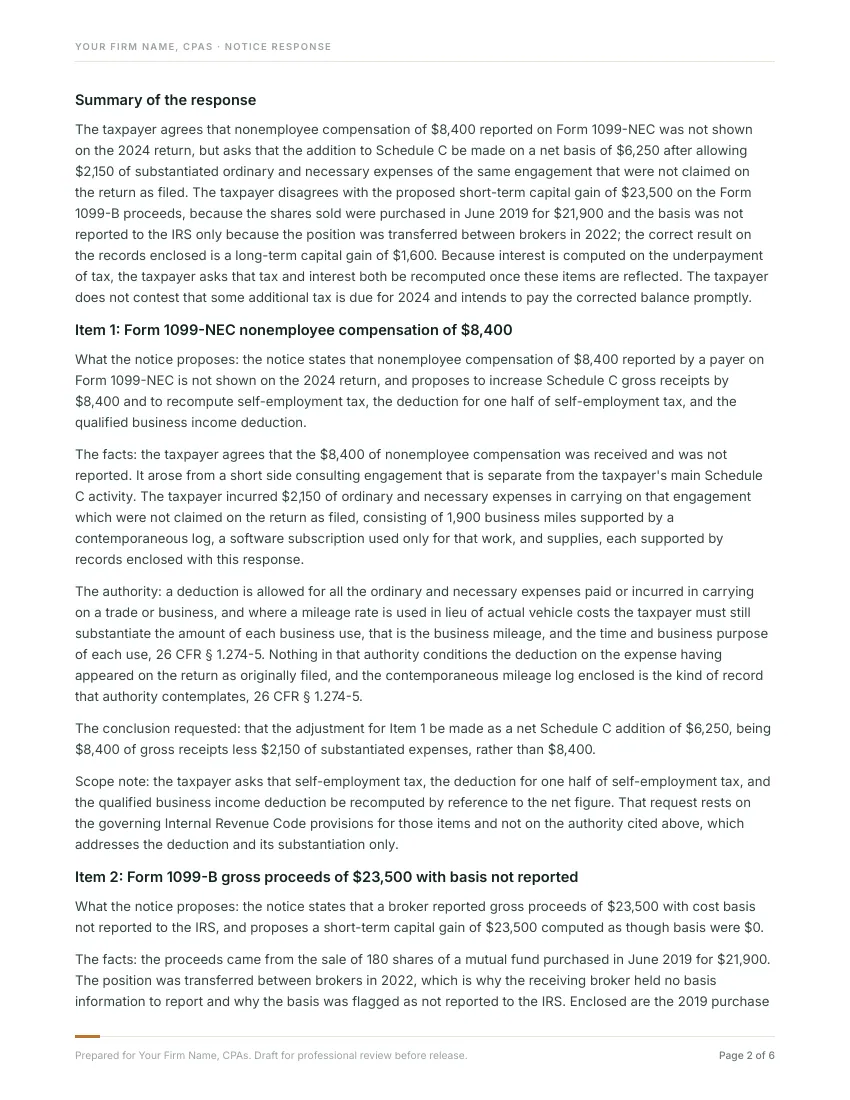
- Notice responsea CP2000, partly agreed · 6 pp
- Penalty abatementlate 1120-S, first-time abatement · 6 pp
- Research memohome sold after a job move · 8 pp
- Multi-state memoa remote employee in another state · 9 pp
- Client cover letterfrom the review above · 3 pp
- Engagement letterone planning structure · 3 pp
- Amended-return statementForm 1040-X Part II · 2 pp
- Client questionnairebefore the planning meeting · 3 pp
- Protest to Appealsmanagement fees and S corporation wages · 10 pp
- Offshore disclosurean inherited Italian account, streamlined · 9 pp
- Letter ruling requesta section 754 election missed · 12 pp
- Refund claimthree deductions left off a 2023 return · 9 pp
Retrieval-grounded research with a hard citation gate, not a chat window.
- 01
Intake and de-identification
The PDF is read as filed; identifiers are replaced with placeholders before any text reaches a model.
- 02
Enumeration walk
A systematic walk of the return by entity type, with the credit-recovery, state and multistate walks where they apply.
- 03
Retrieval against primary authority
Each candidate becomes a legal question run against the index of Code, regulations, guidance, cases and state stacks.
- 04
Grounding and the citation gate
The citation key must exist, the engine must read the cited text and confirm it supports the claim as written, and the quote it relies on must be in that text.
- 05
Engineering Mode
Candidate structures triaged against the actual numbers, then engineered move by move with deadlines and interactions.
- 06
Cross-check, grade and record
Every material item is tested against the return package itself; contradicted items are withheld by name. The papers end with a diligence record of what was retrieved, relied on and rejected.
The full pipeline, stage by stage, and the evidence grades · what this means under Circular 230
Where it fits in a practice.
One firm license. Pay per request on top.
| Return review (overnight / rush) | 1 / 2 |
| Notice response | 1 |
| Penalty abatement | 1 |
| Research memo | 1 |
| Multi-state and entity memo | 1 to 2 |
| Protest and petition | 1 |
| Offshore disclosure | 1 |
| Letter ruling request | 1 |
| Refund claim | 1 |
| Five letters from a finished review | 0 |
Prices in US dollars. A request that fails on our side returns its credits automatically.
Starter. One overnight review, one rush, or two letters.
A week of reviews for a small firm.
A busy month.
A season.
Three answers, plainly.
What is a credit, and what does it cost?
How do I know a finding is real?
Is this tax advice? Who is responsible?
All 34 questions · decode a notice · security and data handling
Bring us a return you know well, or a notice that is due.
The fastest way to evaluate CitedTax is to run it on a return whose facts you already know cold, then read the papers with a red pen. The second fastest is thirty minutes on a screen share with one set of working papers.
A screen-share through one set of working papers, page by page: grades, proof chains, the withheld list. Bring a return you know well and the second conversation is about your clients, not our slides.