
Before you file, or after. Cited to primary law.
CitedTax reads a return the way a senior technical reviewer would, then walks the Taxes Acts, the statutory instruments, the Upper Tribunal decisions and HMRC's published manuals as they stand today. Every finding comes back cited to the operative text and graded by how firmly that text supports it.
No license, no seats: $40 a request, bought one at a time or by the hundred. Credits never expire. Built for firms, not consumers; the reviewing accountant validates every item. Self Assessment (SA100, SA800, SA900) and Company Tax Return (CT600) packages.
- 9 states
- with their full authority stack, plus federal law, Canada and the United Kingdom, kept apart by jurisdiction
- 3 checks
- before a finding is graded VERIFIED: the key exists, the text supports the claim, the quote is in the text
- Overnight
- for a standard review, or about thirty minutes for a rush, review and planning modes in parallel
- 1 firm
- per workspace: your data, your key, your branding
Watch how a firm uses it, end of day to the next morning.
- 01
One file a day
Before you leave, pick a client whose return you know well. One credit.
- 02
Working papers by morning
Every finding cited to primary law and graded by how firmly the text supports it.
- 03
The client report under your name
You decide what the client sees. Nothing goes out without you.
One engine, one currency. Nine things a credit buys.
Return review
LiveUpload a filed or draft return. Working papers, engineering paper and a curated client report, every item cited and graded.
Enquiry response
LiveUpload the HMRC letter. The engine reads it, pulls the return if your firm has run it, and drafts the cited response in your firm's name. Revisions included.
Penalty appeal
LiveReasonable excuse or special circumstances, with the Finance Act 2009 penalty schedules, the appeal route and the time limits cited step by step.
Research memo
LiveAsk a question about a client. The memo answers it with the fact-to-law chain and evidence grades, addressed to your firm.
Multi-nation and entity memo
LiveA matrix for a client moving between the nations of the United Kingdom, or an entity-choice memo on a specific return. Review-sized research.
Notice of appeal
LiveAppeal an assessment, closure notice or penalty to HMRC within the 30 days, request a statutory review, and hold grounds ready for the First-tier Tribunal.
Offshore disclosure
LiveAn unprompted disclosure to HMRC (Worldwide Disclosure Facility, Digital Disclosure Service, Let Property Campaign): the years HMRC can reach, the penalty reductions, the computation.
Clearance application
LiveA clearance application to HMRC: transactions in securities, share exchanges and reconstructions, demergers, purchase of own shares, EIS or SEIS advance assurance, non-statutory clearance.
Overpayment relief claim
LiveA claim for overpayment relief where the amendment window has closed: the grounds, the exclusions addressed, the content HMRC requires.
Included with a review
Free- Client cover letter and "why we recommend amending" letter
- Engagement letter
- Amended return explanation (SA100 under section 9ZA, or CT600 under Schedule 18 paragraph 15)
- Client planning questionnaire
- "What the latest Finance Act changed for you" note
Read the deliverables before you talk to us.
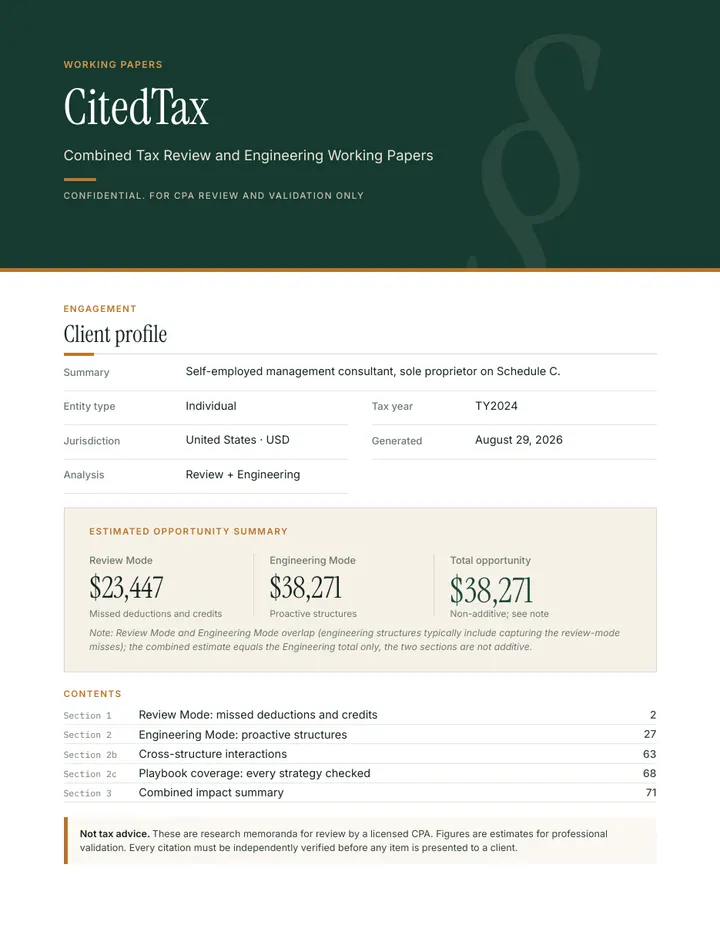
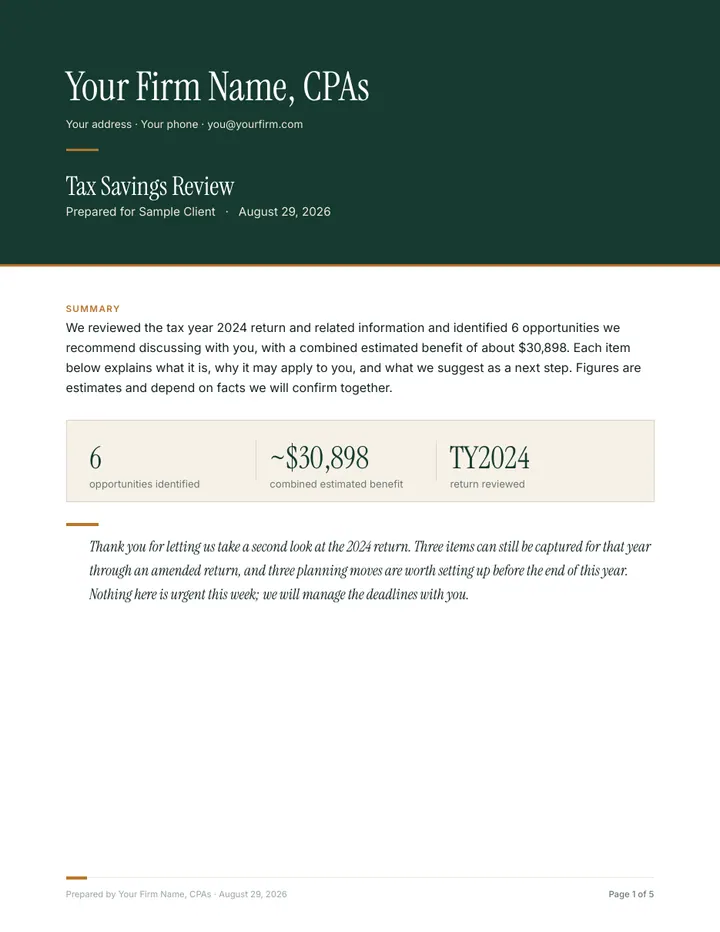
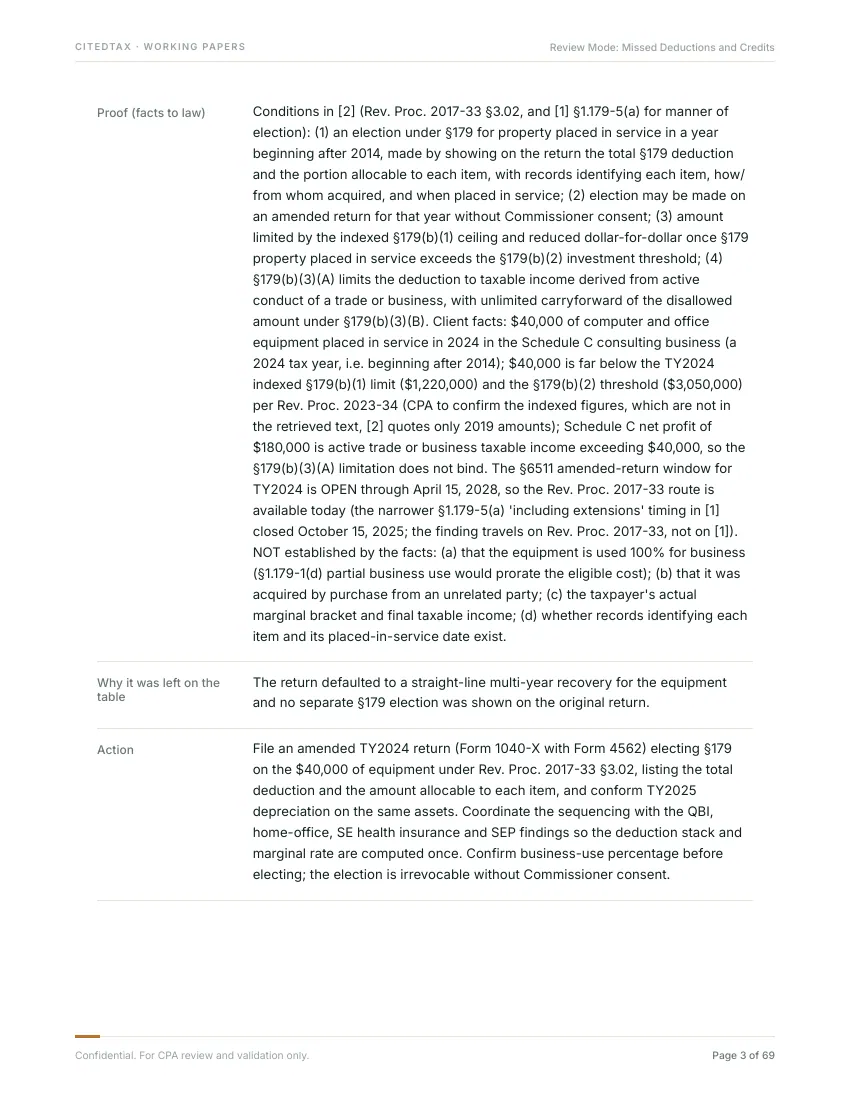
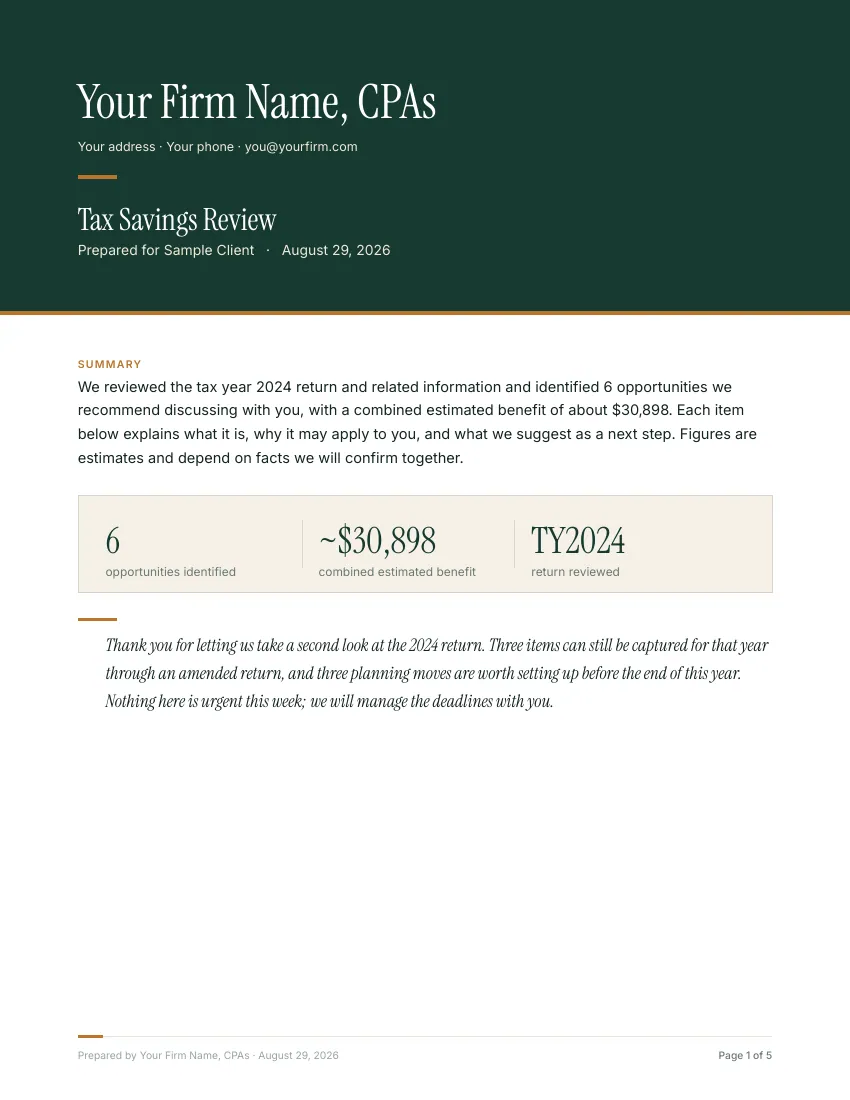
The samples are rendered from synthetic fact patterns (a Sheffield precision engineering company, CT600 for the year to 31 March 2025; a Manchester owner-manager, SA100 for 2024/25) so they can be shared freely. The grades you see are the ones the gate gave them.
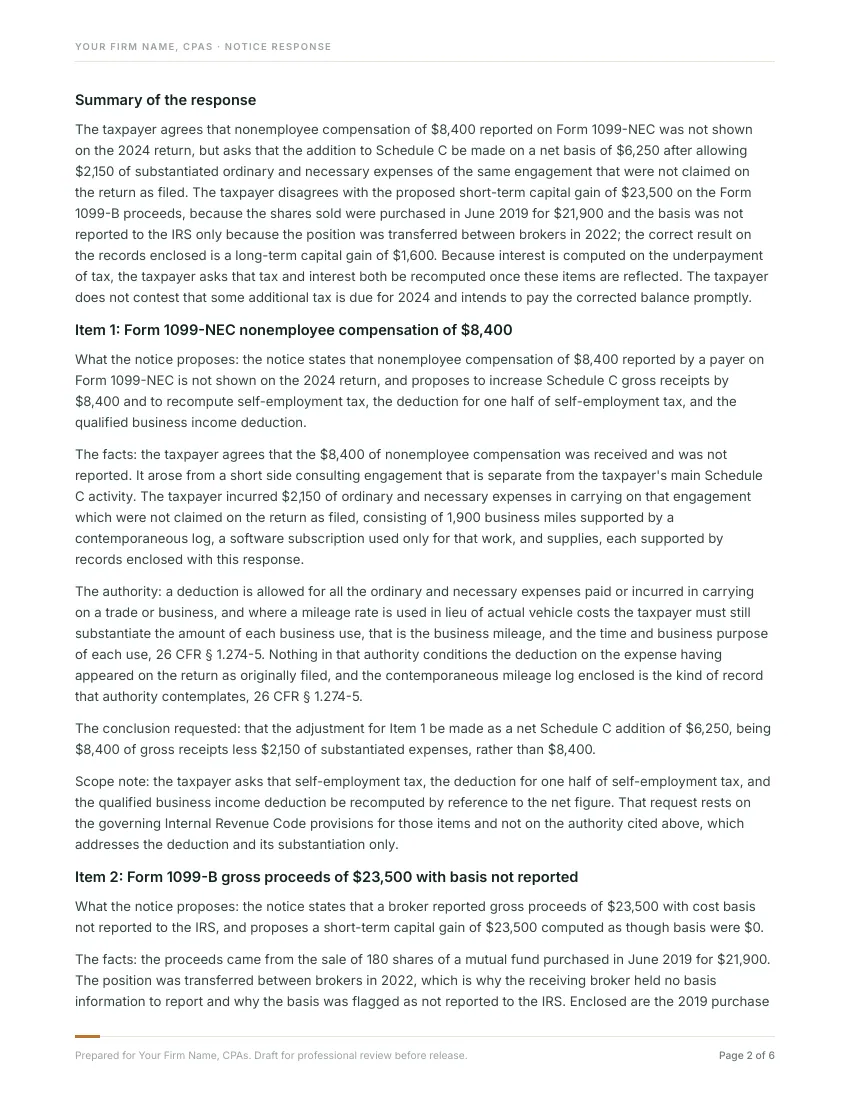
One sample of every other request.
Same rule: synthetic facts, run through the engine, so every citation grade you see is the one the gate gave it. The firm name is a placeholder; the sections marked for the firm to remove before sending are left in.
- Enquiry responsea section 9A enquiry into a plumber's return · 6 pp
- Penalty appeallate filing after a bereavement and a stroke · 8 pp
- Research memobusiness asset disposal relief on a share sale · 10 pp
- Multi-nation memoa move from Manchester to Edinburgh · 12 pp
- Notice of appeala closure notice on subcontractor costs · 8 pp
- Disclosure to HMRCa Spanish let and a Jersey account · 9 pp
- Clearance applicationa holding company by share exchange · 8 pp
- Overpayment relief claimfinance costs left off a 2022/23 return · 8 pp
Retrieval-grounded research with a hard citation gate, not a chat window.
- 01
Intake and de-identification
The PDF is read as filed; identifiers are replaced with placeholders before any text reaches a model.
- 02
Enumeration walk
A systematic walk of the return by entity type, with the credit-recovery, state and multistate walks where they apply.
- 03
Retrieval against primary authority
Each candidate becomes a legal question run against the index of Code, regulations, guidance, cases and state stacks.
- 04
Grounding and the citation gate
The citation key must exist, the engine must read the cited text and confirm it supports the claim as written, and the quote it relies on must be in that text.
- 05
Engineering Mode
Candidate structures triaged against the actual numbers, then engineered move by move with deadlines and interactions.
- 06
Cross-check, grade and record
Every material item is tested against the return package itself; contradicted items are withheld by name. The papers end with a diligence record of what was retrieved, relied on and rejected.
The full pipeline, stage by stage, and the evidence grades · what this means under Circular 230
Where it fits in a practice.
Pay per request. Nothing else.
| Return review (overnight / rush) | 1 / 2 |
| Enquiry response | 1 |
| Penalty appeal | 1 |
| Research memo | 1 |
| Multi-nation and entity memo | 1 to 2 |
| Notice of appeal | 1 |
| Offshore disclosure | 1 |
| Clearance application | 1 |
| Overpayment relief claim | 1 |
| Five letters from a finished review | 0 |
Prices in US dollars; UK firms are billed in USD. A request that fails on our side returns its credits automatically.
Type the number of credits you want, from 1 to 2,500. The price per credit is the same at every quantity.
Card, or instant bank payment where offered, for purchases up to $5,000, with the credits available at once. Larger purchases are paid by ACH debit from a US bank account. An invoice is issued for every purchase.
Buy in October and use the last credit whenever you need it. No monthly reset, no use-it-or-lose-it.
Unlimited users in one workspace, white-label client reports, the curation screen and the activity log, all included.
Three answers, plainly.
What is a credit, and what does it cost?
How do I know a finding is real?
Is this tax advice? Who is responsible?
All 34 questions · decode a notice · security and data handling
Bring us a return you know well, or a notice that is due.
The fastest way to evaluate CitedTax is to run it on a return whose facts you already know cold, then read the papers with a red pen. The second fastest is thirty minutes on a screen share with one set of working papers.
Questions, a walkthrough, anything at all: hello@citedtax.com. A person replies.
A screen-share through one set of working papers, page by page: grades, proof chains, the withheld list. Bring a return you know well and the second conversation is about your clients, not our slides.